top of page

art
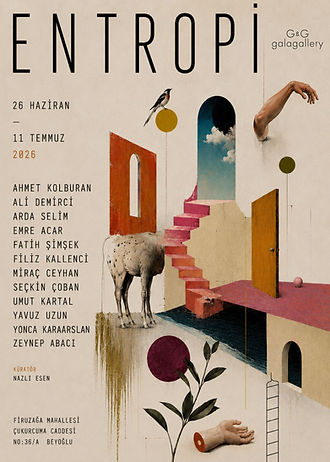
ENTROPY
June 26 - July 11, 2026
Entropy is a concept that describes the gradual dissolution of order over time. In this exhibition, however, entropy refers not so much to a physical process of disintegration as to the fractures that emerge in humanity’s relationship with itself and with the world it has constructed.
Human beings constantly create structures in order to make sense of and exert control over their surroundings. We build cities, form communities, develop systems of belonging, and construct identities. We design a world that we believe belongs to us and attempt to find our place within it. Yet over time, these very structures begin to generate their own tensions. While humanity remains the architect of its world, it also becomes increasingly alienated within it. The works brought together in this exhibition explore different manifestations of this alienation. Oscillating between human and animal, nature and city, reality and dream, memory and forgetting, the images reveal the fractures that define contemporary existence. Almost none of the works are entirely realistic or entirely abstract. Instead, they inhabit spaces where clear boundaries dissolve and established categories lose their certainty.
The recurring human-animal metamorphoses that appear throughout the exhibition emerge from this context. These transformations are not expressions of a return to a primitive past, but reflections of aspects of ourselves that have never truly disappeared. Instincts, desires, fears, and impulses do not vanish; they are suppressed, postponed, or redirected into other forms. While culture, morality, social roles, and identities settle upon these deeper layers, what lies beneath continues to exist and occasionally resurfaces. The deformations and hybridizations present in the figures make this porous terrain visible.
For this reason, the figures within the exhibition often appear suspended in states of uncertainty. They move between human and animal, consciousness and the unconscious, desire and repression. Bodies dissolve, mutate, and reform. Identity is not presented as something fixed or stable, but as an ongoing process of construction, collapse, and reconstruction.
Cities, memory, gender, power structures, trauma, and belonging form additional layers of this process of dissolution. Human beings are not only in conflict with their own bodies, but also with the spaces they inhabit and the systems they create. The distance between the promise of order offered by modern life and the fragmentation experienced by the individual continues to widen. As the search for belonging intensifies, so too does the feeling of rootlessness. The grotesque figures, distorted bodies, fragmented spaces, and surreal atmospheres that populate the exhibition are therefore not merely aesthetic choices; they are visual manifestations of contemporary psychological and social tensions.
Within this context, the absurd emerges not simply as an aesthetic language or mode of representation, but as a strategy of existence and survival. The human mind cannot always grasp chaos directly; instead, it often experiences it by normalizing it, transforming it, or absorbing it into the absurd. In a world where contradictions become ordinary and the exceptional becomes part of everyday life, the absurd offers one way of approaching reality itself. This is why the grotesque and unsettling images encountered throughout the exhibition do not merely provoke discomfort; they also feel strangely familiar. This tension is precisely what draws the viewer in. The monster that appears before us is not entirely foreign. It is another face of what has been repressed, forgotten, concealed, or avoided. The viewer does not observe it from a distance; they are already living alongside it.
What we are experiencing today is not merely a social crisis. It is also a normalized state of collective and individual madness,. The monsters that emerge throughout the exhibition arise precisely from this condition. They are not external threats, but transformed manifestations of what has been kept within. And perhaps the most unsettling realization is that the monster was never outside to begin with.
Nazlı Esen


bottom of page